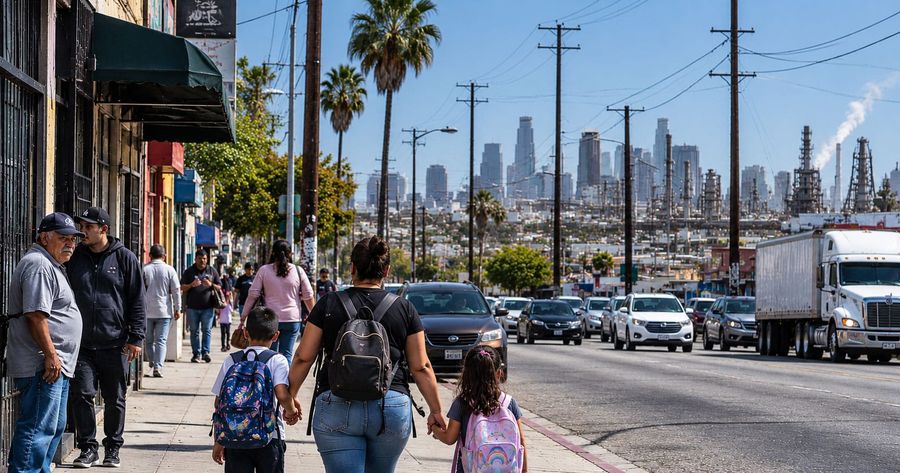

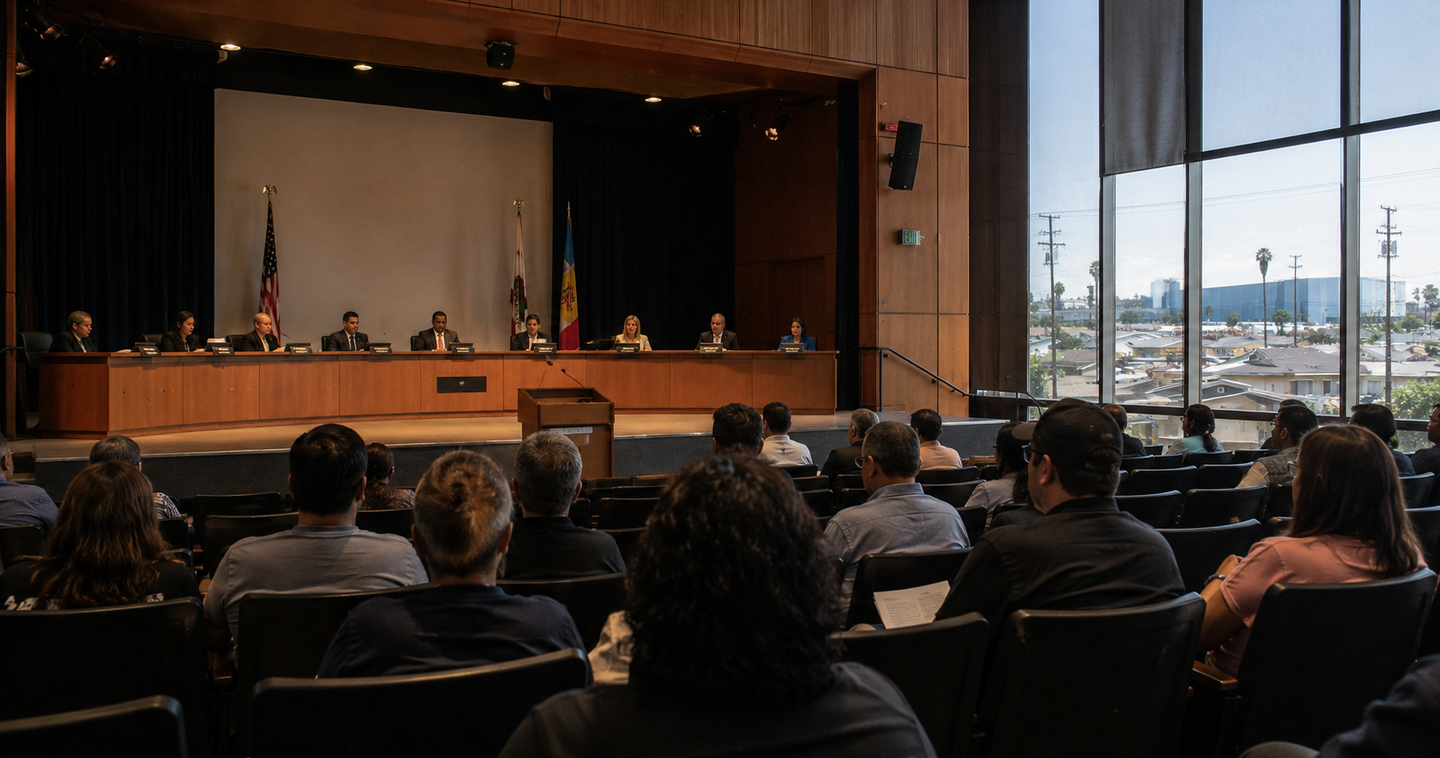
This week on The Signal, accountability takes center stage across three Southern California fights: a proposed state framework for oversight of private immigration detention, the long recovery from the Lineage Logistics fire in Boyle Heights, and local battles over AI data centers. From public health to environmental justice and local control, elected leaders confront who pays, who decides, and who answers. Aired live on KPFK 90.7 FM Los Angeles, on August 8, 2026.

This is viewer supported news. Please do your part today.
TRANSCRIPT
This is a rush transcript. Copy may not be in its final form.
00:00:01:00 - 00:00:06:17
MUSIC INTRO
who nobody elected. What can't possibly last?
00:00:06:19 - 00:00:10:08
MUSIC INTRO
I'm going to tell you what I'm saying.
00:00:10:09 - 00:00:11:02
MUSIC INTRO
But you really only.
00:00:11:02 - 00:00:16:17
MUSIC INTRO
Have to remember I took two words.
00:00:16:19 - 00:00:23:23
MUSIC INTRO
To cover my.
00:00:24:01 - 00:00:26:21
MUSIC INTRO
Life.
00:00:26:22 - 00:00:29:22
MUSIC INTRO
I'm not just. Good afternoon. And when I start this show.
00:00:29:22 - 00:01:05:11
DINO
Welcome to another episode of The Signal. News, information and analysis. I'm your host, Dino. And, you know, let's start off by just acknowledging, recognizing, appreciating those of you who have and continue to support this important public radio institution that's been around now for well over 60 years, helping pave the way, and has done so again for decades, for not just this particular radio network, for many other, networks that it's inspired.
00:01:05:13 - 00:01:35:12
DINO
So I want to thank all the listeners, sponsors who contributed during our recent fund drive and remind you all that we are able to bring you this kind of news, information and analysis because you are supporting us. So thank you. Thank you very much. And that goes to all our, listening areas. 98.7 FM and Santa Barbara, 93.7 FM in San Diego, and of course, 99.5 FM, our friends over in Ridgecrest, China.
00:01:35:12 - 00:01:48:11
DINO
Lee, you know, this afternoon we got, a great program lined up for you. This hour, we're tracking three stories that show what accountability looks like and does so at very different levels of government.
00:01:48:13 - 00:01:49:14
CUT
First.
00:01:49:16 - 00:02:23:23
DINO
We're going to talk to a California lawmaker who is trying to bring state oversight into a system that has operated almost entirely outside public view, and that is the private immigration detention system. State Senator Sasha Renée Pérez joins us to talk about SB 995. We then turn it over to Boyle Heights, where Council Member Isabel Corrado is moving a seven motion legislative package through City Hall in response to the limited logistics fire, covering everything from immediate relief to long term structural reforms.
00:02:24:01 - 00:02:47:11
DINO
And then we'll close out the hour with Council Member Elizabeth Yang of Monterey Park and Doctor Cynthia Gonzalez, mayor of the city of Cudahy. Two local leaders who've each led their cities through fights over artificial intelligence and data centers. So it's going to be a, a jam packed program. And I don't know if you noticed this, right.
00:02:47:11 - 00:03:13:07
DINO
If you paid attention, all public officials, strong, public officials who are helping lead the way. And this is why this station matters so much. Because we bring you these type of opportunities to hear directly from public officials, those you elect. So let's get into it. Right. And we're going to start off with this broader, discussion about the current immigration detention system.
00:03:13:13 - 00:03:47:20
DINO
Now, I want to contextualize this a bit before we go to Senator. When I Perez, you know, the numbers themselves tell us something extraordinary, folks, even as we acknowledge that getting precise counts has become increasingly difficult. And let me tell you why. Ice divides immigration enforcement into a maze of categories, encounters, arrests, detentions, bookends, temporary custody transfers, removals, deportations, different sources count, different stages of their process, and ice own reporting can oftentimes lag does lag.
00:03:47:22 - 00:04:16:04
DINO
So when we say roughly 68,000 people are currently sitting at immigration detention, or at least 20, where at least 24 people have died under Ice custody. Those should be understood as documented numbers, not necessarily the full human toll. And that scale is staggering, folks. Tens of thousands of people are cycling through detention centers every single month during the month of July.
00:04:16:04 - 00:04:41:15
DINO
Ice arresting, Ice reported arresting well over 1400 people a day. Some of us argue that it's likely a lot more. But according to their numbers, roughly one person every minute, with some days reaching or exceeding 2000 arrest, 2000 arrests. And remember, if we think back to some of the declarations made early on, the goal was to do over 3000 arrests.
00:04:41:17 - 00:05:10:17
DINO
So, you know, let's bring it back home. And of course, one of the points of contention here in Southern California has been the, the Lando detention system, or detention center, rather, which remains the largest immigration detention center in the state, run by Geo Group, which is under federal contract and reports, of overcrowding, medical neglect and limited access continued to surface as the detained population continues to grow every year, every day.
00:05:10:19 - 00:05:43:02
DINO
Now, one additional point. I think that's important. A little bit of more background is Stanford Law Review piece recently, articulated on how privatized detention and immigration federalism describes this structural accountability gap. The federal government sets immigration policy, but private companies run these buildings, and researchers argue that the split leaves no single level of government fully responsible for the conditions on the ground.
00:05:43:04 - 00:06:22:06
DINO
A separate Government Accountability Office review of federal inspection programs reached a related conclusion, finding that oversight efforts still lack clear goals or consistent performance standards. That's the gap. California lawmakers are now trying to close this on the state side, Senate Bill 995, known as the Mazuma Con Justice Act, would give Californians California new authority to inspect private detention facilities operating inside the state and enforce basic health and safety standards, regardless of who folds.
00:06:22:08 - 00:06:51:23
DINO
Who holds that federal contract. State Senator Sasha Perez represents California's 25th Senate district and is based out of the primarily Pasadena area that's surrounding communities. And she's back with us today. She is the author of SB 995, the Massive Injustice Act, legislation that, again, would establish a state wide inspection and compliance framework. Senator, Sasha Renée Pérez, welcome back to the Signal.
00:06:52:01 - 00:06:53:12
SASHA RENEE PEREZ
Thank you for having me.
00:06:53:14 - 00:07:32:02
DINO
Thank you, Senator. And we know that you have lots going on, certainly in this issue area. And, you know, Senator, before we get into SB 995, I want to start with Adelanto. We've been tracking your work, since I think the last time we had you on the show and you've been an outspoken critic, you've authored multiple pieces of legislation that seek to mitigate not only the impact that this catastrophic policy is having on our communities, but, you know, bring it in, rein it in, and in your observations over the last, you know, legislative period, what has what have you seen happening over there in other London?
00:07:32:04 - 00:08:05:17
SASHA RENEE PEREZ
Yeah, I, I, you know, I, I have to share with you I, I think the situation at Adelanto has only gotten worse since I began my advocacy around this issue, I think. And I you know, I do want to highlight that there has been issues with Atalanta's detention center even prior to Trump's term. I mean, I remember during Trump 1 in 2016, attending a protest at the facility because there were concerns about health and safety issues inside of the facility.
00:08:05:17 - 00:08:37:07
SASHA RENEE PEREZ
And so since then, we have really just seen I mean, just things get so much worse. I mean, to a level that I don't even think any of us could have imagined. I mean, we've seen individuals that are participating in hunger strikes be retaliated against, you know, be moved to other facilities. Most recently, I've seen videos of, water with worms and, I mean, this is this is just utterly insane.
00:08:37:07 - 00:08:40:03
SASHA RENEE PEREZ
These have become concentration camps.
00:08:40:05 - 00:09:05:08
DINO
You know, I do appreciate that context because I think it's a great segue into, you know, this important piece of legislation that you are advancing SB 995, the massive McCone Justice Act at its core. What does this piece of legislation do, or what what gap in California's current oversight system are you trying to close?
00:09:05:10 - 00:09:33:23
SASHA RENEE PEREZ
So right now, the way that we do oversight of detention facilities here in California is we allow for counties, county, Department of Public Health to be able to do oversight and enforcement. Now the challenge has become is that depending on the kind of political leanings of the county, it's really up to them to decide whether or not they would like to investigate these facilities.
00:09:33:23 - 00:10:08:03
SASHA RENEE PEREZ
And so, most recently, San Diego County and the federal government were in a lawsuit over whether or not San Diego County has the right to investigate Otay Mesa Detention Center. And the judge ruled that they do have that right. And so they are now going to be doing an investigation. But there are other counties, for example, the county, that represents California Cities Detention Center, which leans conservative, and they have not expressed an interest district despite public outcry to do the investigation.
00:10:08:03 - 00:10:31:15
SASHA RENEE PEREZ
And so, you know, after looking at what the the compliance framework looks like here in the state, I realize that we really needed to take it to California's Department of Public Health to do these inspections. We we cannot leave it to the county. This is a statewide issue. These have actually become national issues. And that is why we've created this framework.
00:10:31:15 - 00:10:41:15
SASHA RENEE PEREZ
So that California Department of Public Health can investigate and ensure that these facilities are meeting basic public health and public safety standards.
00:10:41:17 - 00:11:20:06
DINO
So you're making the distinction that, you know, and I found this to be very interesting when I first read this piece of legislation that, you know, obviously, California doesn't control federal immigration policy, but these facilities, as you point out, are physically operating inside California and holding people within our state. So just so that our listeners can have a clear understanding where exactly does California authority begin and end relative to the bill, and what challenges should or are you anticipating, from the Trump administration and saying like, this is a federal issue?
00:11:20:08 - 00:11:56:03
SASHA RENEE PEREZ
You know, I think the Trump administration has been very open and blatant about the fact that they are going to sue the state, at every opportunity to try to get away with breaking the constitution, to try to tear away our tax dollars, to try to avoid the enforcement of our laws. So I, I have no doubt that there will be challenges that in the future around many of the laws that we're working on related to these issues.
00:11:56:03 - 00:12:34:02
SASHA RENEE PEREZ
Right, because the federal government, this administration, does not want any oversight and accountability from the state, but the authority that the state of California has is around making sure that private contractors, private companies are meet the law. And when you have a company like Geo Group, when you have a company like Core Civic that is actively breaking the law, actively committing human rights violations, this state has the authority and the ability to come in and do enforcement.
00:12:34:04 - 00:12:58:09
SASHA RENEE PEREZ
All of these private entities must meet public health and public safety standards. That is the law here in California. And if they are not doing so, then the state needs to provide some sort of enforcement, and we need to ensure that all of the entities that are working with that private company, as well as the public, are aware of what is happening.
00:12:58:10 - 00:13:29:12
DINO
We're speaking with State Senator Sharon Perez, who represents California's 25th Senate district, regarding her, her bills, SB 9.95, the Masoom Khan Justice Act, which is legislation that would establish a statewide inspection and compliance framework for private detention facilities operating in California. Facilities like the now infamous Adelanto Detention Center. And Senator, you know, inspections only matter if there's some ability to address what inspectors actually find, right?
00:13:29:12 - 00:13:47:16
DINO
So what enforcement mechanism does SB 995 provide when violations are identified, particularly when a facility repeatedly fails to meet required health and safety standards? In other words, what, what if they simply don't want to follow what happens?
00:13:47:18 - 00:14:28:04
SASHA RENEE PEREZ
So what we have built into SB 995 is a framework that works and stops. So what happens first is that the California Department of Public Health would come inside the facility. They would do their investigation, ensure that the facilities meeting public health and public safety standards, if they find that there are violations of public health and public safety standards, they have the ability to initiate fines if they find other concerning behavior, because we have also heard direct stories from individuals that have been held in, for example, in center that have experienced sexual assault, that have experienced sexual violence.
00:14:28:06 - 00:15:02:17
SASHA RENEE PEREZ
We're giving the agency the authority to refer those issues to the appropriate state agency if they need to make referrals to law enforcement. And if we continue to see repeated violations, then taking that information to report it to their insurance companies, looking at if we are able to pull their permits, right, so that we can stop these operations at the end of the day, we cannot have corporations that are profiting off of human suffering, and that is essentially what Geo Group and Core civic have been doing.
00:15:02:17 - 00:15:05:21
SASHA RENEE PEREZ
And it is utterly disgusting and unacceptable.
00:15:05:23 - 00:15:20:16
DINO
Senator, as we wind down, in this final minute, where is the the bill now and how can folks learn more about the work that you're doing? And in particular about this bill, SB 905.
00:15:20:18 - 00:15:42:21
SASHA RENEE PEREZ
So the bill right now is in the Assembly Appropriations Committee. Those that are supportive of the bill, we're encouraging them to reach out to the chair. Assembly member Buffy Wicks, who will determine this bill, say it is one of my office's top priorities, given what we've seen nationally happen around this issue, as well as here in the state of California.
00:15:42:23 - 00:16:04:06
SASHA RENEE PEREZ
You know, folks are interested in continuing to follow the work that we're doing on this bill as well as others. Right? We are we are leading an enormous amount of work to really take on and fight back against the federal administration. They can follow me online at Senator SRP or Sasha Renee Perez. If you type in my name website will come up as well.
00:16:04:06 - 00:16:11:12
SASHA RENEE PEREZ
You can see our official web page and if you have any questions for our office, you know, please reach out. We are here to help and serve.
00:16:11:14 - 00:16:28:23
DINO
State Senator Sasha Perez, representing California's 25th Senate district, on her bill, SB 995, now having made its way through the Senate on the Assembly. Senator, thank you again for joining us. We'll be tracking this. We look forward to having you back when your bill succeeds.
00:16:29:01 - 00:16:29:22
SASHA RENEE PEREZ
Thank you. Thank you so.
00:16:29:22 - 00:16:53:20
DINO
Much. Thank you. And stay with us, folks. When we come back, we're going to head on down to L.A. and, check in with our, friends in City Hall and get an update on the, lineage logistics fire recovery process with, our guests, Isabel Hood, other council, district, council member from the city of L.A..
00:16:53:20 - 00:16:54:17
DINO
We'll be right back.
00:16:54:21 - 00:16:55:10
MUSIC INTRO
I'm going to tell you.
00:16:55:10 - 00:17:06:03
MUSIC INTRO
The numbers that you are listening to, but you really only have to remember to talk to a signal. There's a signal.
00:17:06:05 - 00:17:20:23
MUSIC INTRO
Coming with Mighty Dino only on Kpfk, 90.7 FM, Los Angeles I in the US.
00:17:21:01 - 00:17:48:03
DINO
Welcome back to The Signal. It's now been several weeks since the limited logistics fire in Boyle Heights, broke out and, led to this, devastating impact on local communities in the area. Cleanup crews have made some progress. At least from the images that we've been able to follow online and through other news sources. But residents are still asking hard questions about testing, transparency and what happens next.
00:17:48:05 - 00:18:17:00
DINO
You know, one piece of background that our researchers here on the signal just shared with me before we went on air, they were sharing with me the researchers who study industrial fires in urban settings, have found that nearby communities are almost always disproportionately low income, disproportionately communities of color, and that health effects from fine particulate matter often exceeds international guidelines.
00:18:17:02 - 00:18:40:15
DINO
This is one of the things that we've continuously heard as we've covered this issue. We've now, I think just about every week that we've been on the air, we've had some update, including from our next guest, Council member Jurado who recently introduced a seven motion legislative package in response to the ongoing challenges around the initial logistics fire in Boyle Heights.
00:18:40:16 - 00:18:44:03
DINO
Council member who other. Welcome back to the signal.
00:18:44:05 - 00:18:46:23
YSABEL JURADO
Thank you so much, Dino. Happy to be here.
00:18:47:01 - 00:19:06:09
DINO
Well thank you. And so before we get into this package of legislation you've introduced, let's start where where things stand today. Again, when we were doing the prep show before we went on air, we were kind of all looking around and seeing some of the images of what looks like a partial empty warehouse, numbers that indicate that as much as 80% has left.
00:19:06:09 - 00:19:25:11
DINO
But then, you know, you flip the page and see reports of ongoing challenges with everything from continued, the continued issue of odor, you know, rats infestations and what have you. What is the latest update that you can give us from your office in terms of your observations? There?
00:19:25:12 - 00:19:51:03
YSABEL JURADO
Yes. Well, according to lineage, the logistic warehouse company where the fire, happened, the food waste is 85% cleared. So it's just the food waste. And I can tell you from my firsthand experience of being at the site that this community is not 85% of the way to being made whole again. The odor is still unbearable. Flies are everywhere, and so are birds.
00:19:51:05 - 00:20:16:19
YSABEL JURADO
This week there are new orders from the AQIM that the clean up has to follow better, better standards to address the air quality and smell. But those standards that they're imposing are only a fraction of the issues in the remediation process. There are concerns over pests. And Berman small businesses are losing their income because they can't stay open because people aren't coming.
00:20:16:21 - 00:20:36:03
YSABEL JURADO
There's public health issues. Public trust is eroding. Utility bills. You know, schools starting next week. And people are still feeling like they're in an uncertain future. And, you know, as I was there, a couple of days ago, people still have sitting ash on their cars because they don't want to leave their homes and the smell is too much outside.
00:20:36:03 - 00:20:47:12
YSABEL JURADO
And so we still have a long way to go. And while it's important we keep track of the 45 day deadline that the mayor set forth to clear the food and debris, that's not where the recovery will end.
00:20:47:14 - 00:21:16:08
DINO
So clearly, I see where the inspiration for this, important piece of legislation that you just introduced in City Hall, LA City Hall. And that is this seven package, right? I think it's seven package. Pieces of legislation. So, yeah, let's get into that, council member who although your package begins by addressing immediate relief and accountability, can you walk us through those first measures and explain why you're what you're trying to accomplish with this?
00:21:16:08 - 00:21:20:15
DINO
Why is those two top of the line there?
00:21:20:17 - 00:22:01:19
YSABEL JURADO
You know, we've received thousands of complaints from residents who've made it clear that the relief has been too little and too slow. Air purifiers and grocery vouchers are necessary, and we've given those out. But that doesn't make up for weeks of Boyle Heights family and businesses paying the price for a disaster that they did not cause. And so one of my first motions is exploring a dedicated mitigation response fund, with a total budget of up to $10 million in emergency funds, and this fund will go to fund pest and odor control mitigation support for utility bills, because those air purifiers running around the clock and air conditioners is more expensive than their usual expense.
00:22:01:19 - 00:22:33:11
YSABEL JURADO
Right. Direct case working services, financial assistance for both families and small businesses. And I'm also calling for a faster clean up and asking the state and Governor Newsom to come down and deploy additional resources. We've asked time and time again, but I haven't seen Governor Newsome himself come down to support us. And so really calling upon, the state of California to really support this community that is bearing the brunt of, as you mentioned, his history of environmental justice at the cost of this community.
00:22:33:13 - 00:23:07:13
DINO
Excellent Segway, Assembly member, because another part of the package focuses on environmental safeguards and transparency. And one of the frustrations that we've heard I've heard myself, I've been to some of the, some of these, opportunities that have been created by your office and others, where you're engaging stakeholders in the community is that the fire has, has created a very there's this disconnect between the amount and type of information that is available.
00:23:07:15 - 00:23:33:01
DINO
What protections are in place, you know, it's been quite a quagmire of, you know, state, local, city, county. I mean, so what changes are you proposing and how we how would they change the city's response next time? Unfortunately, when it happens, because I think these situations tend to happen every so often. But what are the changes that you're proposing?
00:23:33:02 - 00:24:04:21
YSABEL JURADO
One of the changes that I'm proposing in response to this, possibly, I mean, happening again because of the juxtaposition of these major industrial facilities by residential places, is that we are putting an interim control ordinance in place, which would prohibit issuing permits for large cold storage warehouses like lineage near residential areas, because we cannot treat this, you know, these kind of facilities and neighborhoods like business as usual.
00:24:04:21 - 00:24:31:02
YSABEL JURADO
We have to actually learn from this. So pausing the permits on these type of facilities near residential areas is number one. Number two, we're also forming, you know, environmental justice Advisory and Advocacy Commission, which will be a platform for people in these overlooked communities to have a direct role in advising the mayor and city council and environmental justice policy.
00:24:31:08 - 00:25:01:16
YSABEL JURADO
We know that this is not just an East Side issue. This is a harbor issue. This is a South L.A. issue. This is a Valley issue. And these neighborhoods have carried too many of the city's environmental burdens for generations. And residents should not shoulder the cost of this recovery, and they should never have to do it again. So having this commission is super important to inform us and have residents who know best what what the stakes are and how they would like to see the changes and have them help inform the policy.
00:25:01:18 - 00:25:34:17
YSABEL JURADO
And lastly, like I mentioned, these residents in the Cause of disaster, they shouldn't be the ones having to foot the bill and so ensuring that the response of those responsible for containing this disaster and protecting the surrounding community have to control the odor and accelerate the cleanup. And so, you know, we are trying to increase stronger financial penalties ranging from 25,000 to $1 million for serious violations, because right now the fines are like $500 a day, something like $1,000 a week.
00:25:34:17 - 00:25:59:09
YSABEL JURADO
And what does that even mean to a multibillion dollar company? And we need just the largest warehouse logistic operation in the world. So that's like pennies, right? How can we incentivize them to actually clean up their act and provide, you know, reparations in a sense, to the community with whom they've harmed? And so increasing those penalties to be something that is serious and that they have to take it seriously.
00:25:59:15 - 00:26:33:10
YSABEL JURADO
And also looking at how those fines and fees can be turned back into, the community and contributing to the caseworkers who can help each of these constituents access all the resources, because emergency or no emergency, without someone walking folks through, the resource process. You know, sometimes we can access it. And these folks are monolingual, you know, bedridden and seniors, you know, they're working people who don't, you know, that are trying to take care of their multigenerational households.
00:26:33:10 - 00:26:42:23
YSABEL JURADO
So they need someone to help them out and walk them through the process and actually see it through. And so making sure that the fines are serious enough to actually hurt the company.
00:26:42:23 - 00:27:12:14
DINO
And motivate them to actually act right. Sometimes the lesson best learned comes at an expensive price point. Yeah. We're speaking with the City of Los Angeles Council member E7, who rather who represents Council District 14, which includes part of the, well, includes the Boyle Heights community. And we're discussing the Lineas Logistics fire update. Clean up and a seven motion package that, council member who the other just introduced at City Hall upon the return from council break.
00:27:12:19 - 00:27:44:07
DINO
Although I can speak to, first hand, I know that most of you did not take a break in the last couple of weeks. Council member, as we wind down, I know that part of your motions are looking, at a much more long term, you know, long term work, right? The remaining motions seem to take a longer view, moving beyond the immediate response to, looking at more structural reforms.
00:27:44:09 - 00:28:18:07
DINO
And we know that, you know, first hand as somebody who's been and in this city, well, born and raised and I've covered politics for 30 years and have even been a part of the public policy, network, these things can sometimes take a long while. So as you look to structure some of these reforms, with a vision towards long term application, how will that be navigated in a system that sometimes takes 2 or 3 years to pass, pieces of legislation?
00:28:18:09 - 00:29:03:04
YSABEL JURADO
Oh, yes. Yes. You know, I'm someone who hates bureaucracy and trying to make sure that we get outcomes as soon as possible. And so one of the things that I pushed for during this council recess is to make sure that we have a committee focused on the Boyle Heights recovery and so, in the next coming weeks, council president is, approving, authorizing a committee where I will helm that is focusing on the recovery and results and making sure that we're holding our departments accountable and turning empty promises into real action by having these council meetings where people will have to publicly answer as to what are they doing, what's in the water, what are
00:29:03:04 - 00:29:25:10
YSABEL JURADO
the results saying? And having constituents be able to have a space where they can voice their concerns, because some of these agencies, hear about, you know, I've been an advocate for the community, have been on the ground and trying to talk to these agencies and tell them what people are experiencing. But it's not the same as them hearing it from the folks in mass.
00:29:25:12 - 00:30:00:15
YSABEL JURADO
This past week when we went to the Acmg hearing, you know, folks were talking about how their eyes were swollen, their noses were stolen, they couldn't breathe. They're afraid to go out. You know, their elderly mom, they have to drive to their appointment is having respiratory issues. And when folks, that are in departments that maybe don't go out and they're at their desk or dealing with data, see and hear that qualitative, you know, research in person, I think it has a distinct, different impact on them and the work that it is and that this cannot be business and usual.
00:30:00:15 - 00:30:21:08
YSABEL JURADO
And so in that committee, I'm going to push for stronger, you know, outcomes and faster results, because that's what our residents really deserve. And I don't want them to feel like they're navigating it alone and that they're not getting the answers they need. And so that was an important step to make sure that there's accountability.
00:30:21:10 - 00:30:52:21
DINO
Well, we, dodged, doctors looking at the at our next guest, City of Los Angeles council members of and one other. I want to thank you for joining us again. Thank you for the update. We look forward to, following the progress and wish you luck with your legislative package. Folks, stay with us. As we come back, we're going to head over and start talking about AI, artificial intelligence, data centers, and the fight over local control with two additional public servants.
00:30:52:23 - 00:31:08:01
DINO
Who have been, you could argue at the forefront of this one helped lead, her city into becoming the first in the nation to ban a data center. And the other just did it days ago. Stay with us. We'll be right back.
00:31:08:04 - 00:31:10:04
MUSIC INTRO
I'm going to tell you another language.
00:31:10:05 - 00:31:33:21
MUSIC INTRO
Estas escuchando. You really only have to remember I took two words the signal con el poderoso vino sola for a copy of the novel puntos at the FEMA Los Angeles. I'm not just the American government. But government.
00:31:33:22 - 00:32:13:23
DINO
Welcome back. So, folks, we're going to take a deep dive as much as we can in the next 20, 25 minutes into the world of artificial intelligence. Now, I gotta confess, I recently, particularly through my. But I sometimes lovingly referred to as the day job, started embracing the AI world, in part because the staff that, I work with were, you know, besides poking fun at me for being, as my daughter would describe, antiquated, they began to really share with me and show me how, these can be powerful tools.
00:32:14:04 - 00:32:40:22
DINO
Right? But, you know, artificial intelligence may live in the cloud, but the infrastructure powering it is very much underground, and it uses enormous amounts of electricity. California already has more than 200 active data centers. And with the explosive growth of AI and cloud computing and electricity, demand from these facilities is expected to increase substantially over the next 15 years.
00:32:41:00 - 00:33:35:16
DINO
Much of that growth is concentrated in places like Silicon Valley. Putting new pressure on the electric grid that already is navigating rising demands and the transition towards cleaner energy. A new fact sheet, a new recent fact sheet from the Union of Concerned Scientists isn't arguing that California should simply say no to data centers. They are instead raising some pretty fundamental questions, about how we accommodate this growth, who pays for it, and what happens to the communities where these facilities are built without careful planning, UCS warns that data centers could strain grid reliability, increase electricity costs, and slow California's clean energy transition and increase resilience or reliance rather on backup generators, which would bring
00:33:35:16 - 00:33:58:17
DINO
additional pollution. Now, as somebody who is, enjoys the comfort of a good AC, I can tell you, sli that I pay a lot in electricity costs and the idea that I will have to pay more, because I'm also, once in a while using AI, particularly for the radio show. We do use AI for the radio show, which is a lot of where we use it.
00:33:58:19 - 00:34:25:18
DINO
With that said, there are some California cities that are wrestling with how to regulate this rapidly expanding city industry. Excuse me. And some cities have decided that they don't want to wait. They've looked at the demand on electricity. They looked at the demand on water, land and local infrastructure. They weighed those against the promise of economic benefits and said, you know what?
00:34:25:20 - 00:34:51:00
DINO
Pass no. Which brings us to our next segment. The city of Monterey Park, the city of Cudahy, two southern California cities that have taken action to stop data centers from being built in their communities. Joining us to talk about this are Monterey Park Council member Elizabeth Yang and kind of hi, mayor Doctor Cynthia Gonzalez, welcome to you both for joining us here on the Signal.
00:34:51:02 - 00:34:55:09
DR CYNTHIA GONZALEZ
Glad to be on here. Thank you for having us. Yes, thank you for having us.
00:34:55:14 - 00:35:24:18
DINO
So let me start off with you, and let's go over to Monterey Park. Council member, Yang, now, your city has the, pretty, I think pretty dope. The pretty dope, you know, classification as having been the first city across the US to actually say, you know, we're good. We're not going down that path.
00:35:24:18 - 00:35:43:09
DINO
We're going to ban it. And I believe if if my researchers, who are oftentimes caffeinated overcaffeinated are right, this happened earlier this year while you were still mayor at the time in the city. Walk us through that particular process over in Monterey Park. Why did you do it?
00:35:43:10 - 00:36:10:17
ELIZABETH YANG
Well, in in our city, we rotate. Being the mayor is a nine months for each of us. So I started my mayorship in September of 2025. In November, what, data center, application came before our council meeting, by the Australian Company Agency. They had purchased a big life, in our city, and we're planning on building a 250,000 square foot data center.
00:36:10:18 - 00:36:32:18
ELIZABETH YANG
Over the course of the next couple months, we asked them to host community meetings because our community is very residential. And, we had a lot of residents voiced their concerns because we've never had a data center in our city of that size. And they told us they were going to host community meetings. Fast forward to the end of January.
00:36:33:00 - 00:36:58:02
ELIZABETH YANG
Nothing was hosted, and the community got increasingly concerned. We had set up moratoriums in place, and then we, council, passed an ordinance banning data centers. But that wasn't enough for a community. They wanted us to put it on the ballot for a vote. And we did that for the June election and passed by an overwhelming 88%.
00:36:58:04 - 00:37:25:11
DINO
Wow. Okay. So in your city, what it clearly sounds like is that the community came out and said, hey, yo, dig it? We're not actually digging this. We're not liking this idea. You know what? Our our, energy drink fueled research team, did not tell me. And I'm over there giving them bad looks. So you guys actually had an application that came in that first raised this alarm?
00:37:25:13 - 00:37:44:08
DINO
Let me go on over to you and cut off. Hi. Doctor Cynthia Gonzalez, what raised the red flag for you all in the city of got High, which is, you know, just to contextualize this, you're perhaps one of the most, if not the smallest city in the southeast side of L.A. County. And compared to Monterey Park, there's a substantial difference.
00:37:44:08 - 00:37:52:22
DINO
But nonetheless, it's a concern that was raised in your city. What raised that flag? And to start off with.
00:37:53:00 - 00:38:31:14
DR CYNTHIA GONZALEZ
Yes, we didn't have a lot. Thank you. First of all, for having me on, very proud to be representing the city of today. I think for us, we had heard some mentioning nothing ever came to us formally about questions about potential use of land here in Southeast Los Angeles. We already suffer from so much environmental racism that a lot of our development is halted because of the brownfield and how toxic our soil already is, and the issues that we already have with our water, that our state senator has been really leading efforts in trying to help us mitigate a lot of the water issues that we currently have.
00:38:31:16 - 00:39:02:05
DR CYNTHIA GONZALEZ
And honestly, it is following cities like Monterey Park. It's really important that we model for each other how to engage in some of this work, and they do want to elevate our vice mayor here in the city of CA, they had Daisy Lomeli, who was the first to bring the issue. Had attended a conference and had learned more about data centers and their impact and had brought that information back to our city attorney and started trying to move the issue through our planning commission and see Monterey Park go and do this.
00:39:02:07 - 00:39:32:05
DR CYNTHIA GONZALEZ
It actually supported our effort to also do this in our region. So people could say, you are so small, who's going to come in here and do it? I know we have data centers being built. Just a couple of miles away in the city of Vernon already that have been approved. For us, it's important to like, set the tone in this region because whether we had an application or not, it's important for us to let other cities and the community members know that they could push their electeds to do the same thing to protect the region.
00:39:32:05 - 00:39:50:14
DR CYNTHIA GONZALEZ
Overall. For us, it's like we want to model this and come out of here and hope that all of our surrounding cities do the same thing. Because what happens in one city, right when it comes to air and land, just like we're seeing with lineage, I mean, we just you just had a council member, who rather on.
00:39:50:16 - 00:40:11:14
DR CYNTHIA GONZALEZ
Right? There are no borders when it comes to toxins that go into the air and to the broader environmental impacts that communities experience. And knowing that. Right, we want to make sure that we set a tone in our region and that we have others model. And that's what we've seen right now, where residents from other neighboring cities are saying, why aren't you doing the same thing?
00:40:11:20 - 00:40:30:07
DR CYNTHIA GONZALEZ
And we hope that that pressure grows and that we at least show that air centers, data centers don't have a disparate impact on low income communities, and that people have always corporations have always taken advantage of exploiting our communities at the cost of our health and well-being.
00:40:30:10 - 00:40:31:04
DINO
Sure, we want.
00:40:31:04 - 00:40:32:15
SASHA RENEE PEREZ
To start pushing back on that.
00:40:32:21 - 00:41:09:01
DINO
And, you know, back to you, Council Member Yang, you know, I got I got to say, I mean, I feel good hearing somebody like Tara Gonzalez over it and, and and and her city saying, look, we, we we did look at places like Monterey Park. In fact, I want to share with you I've had other guests here from other cities covering other issues, and I can think back to one, a couple of months ago, I had a guest here from another local city, and on the way out, she said, hey, you should look at the story that's coming out of Monterey Park and their banning of data centers.
00:41:09:01 - 00:41:45:11
DINO
And I remember thinking, yeah, no, okay, I'm digging it. And again, this was an elected official recognizing the leadership. The direction that you are provided over in Monterey Park. But, you know, Mary Gonzalez just pointed out something about water consumption. Which brings me to this issue. Right at some of the principal concerns that we've heard coming from folks we've talked to and in preparing for this story has been this issue of electricity, water consumption, environmental impacts, infrastructure, land use, all of these point to quality of life, right?
00:41:45:13 - 00:41:58:03
DINO
When you all started to engage the public, what were you hearing from community members? Was the most elevated concern for them?
00:41:58:05 - 00:42:30:10
ELIZABETH YANG
Many of the concerns or, you know, like what you mentioned, excessive energy use, excessive water use or were afraid their bills were going to go also noise concerns, because there's other data centers in our country, where, you know, the machines are on 24 seven. And so they're afraid that the noise is going to go through into a residence and, cause people not to be able to sleep at night, just a lot of different concerns because that agency company never hosted any community meetings.
00:42:30:10 - 00:42:52:05
ELIZABETH YANG
So till this day, I don't even know the specific details of that project. I, I got personally invited to go to Vernon, and look at some of the data centers there in person. But the proposed project, the inner city, they're not going to be identical to the ones in Vernon. So we never got a full presentation on the one that was proposed in our city.
00:42:52:07 - 00:43:21:19
DINO
Was there opposition? Council Member Yang to this, prohibition? Were there anybody out there besides the actual baby company who was proposing this, whether from the business community or from individual residents who said, hey, this is not a bad thing, reconsider? Or was there just I know that you had a very high rate of support. I think you said 88%, but what has, if any, opposition come forward and and environments or fights like this.
00:43:21:21 - 00:43:44:09
ELIZABETH YANG
You know, at the ballot measure stage. Fortunately, there was no opposition at that point. The data center applicant got smart and decided to withdraw their application. I think they knew even if they dumped a lot of campaign dollars into fighting the ballot measure, they probably weren't going to win anyways because the community was just so against data centers at that point.
00:43:44:11 - 00:44:12:01
ELIZABETH YANG
But if you rewind back to November, December, when when we had the initial council meetings, I had stacks of public comment cards in front of me, and it was about 60% against and 40%. No. And then because of lack of information, lack of community forums, two months later, it was 95% against, 5% for. So the tables turned very quickly and wow.
00:44:12:01 - 00:44:23:08
DINO
Yeah. Okay. That's I'm glad you shared that. That's very interesting. Back to you, Doctor Gonzalez in this city of and I caught it earlier. Right. So let me get this right. Cut away not cut.
00:44:23:08 - 00:44:27:18
ELIZABETH YANG
A high yet. Cut it. Yeah okay. Fair enough. Hey.
00:44:27:20 - 00:45:03:11
DINO
Fair enough. Doctor Gonzalez so in terms of a community there that is disproportionately high number of immigrants, high number of, Duolingo bilingual folks. Or monolingual folks, rather. What has been for you are the information sharing process like and ensuring that the communities fully understand the scope of this? But, as a forthcoming challenge and why you're doing it, or again, was there any opposition from anybody in your city to, to this sub moratorium?
00:45:03:13 - 00:45:34:08
DR CYNTHIA GONZALEZ
No, there really wasn't opposition. I mean, we are trying to get ahead of being in a situation where we are forced to do it right. So that people aren't even thinking, even if they're thinking that that thought go away somewhere else. And so we're actively advocating for our community members. When we actually passed, this ordinance, we had community members come off speaking in favor of us doing this and engaging in this ban.
00:45:34:10 - 00:45:59:05
DR CYNTHIA GONZALEZ
And really no opposition. I think that for us, it's really important because we currently have a pretty progressive majority. Council elections are coming in November, and they think we understand because we've educated ourselves on these data center issues and the causes that and the harms that they will bring to communities that we are able to advocate for our community in that way.
00:45:59:05 - 00:46:24:08
DR CYNTHIA GONZALEZ
I think, you know, given a different council or folks that think differently or think only financially and not, the financial benefits and not like the actual physical well-being. And livelihood of residents that we might have different outcomes. And so I've been very lucky to be mayor at a time when we have a majority progressive council who understands data centers.
00:46:24:08 - 00:46:49:05
DR CYNTHIA GONZALEZ
We, you know, going to trainings around data centers and learning about ways in which we can intercede, because the reality is that right now, at the federal level, there's actually like no legislation and intentionally almost a ban on legislating data centers or AI in any way. So that means that we have to do our work at the local level and doing as much as we can to protect our residents.
00:46:49:07 - 00:47:26:18
DINO
So, you know, if I could play just a tad bit of devil's advocate here, I'm thinking of some of the research that, my folks share with me, particularly that coming out of the Union of Concerned Scientists who, who as they argued, they're arguing that California should simply say no to data centers. But is there something here that speaks to the inevitability of, certain technologies that are at one point or another going to consume our lives?
00:47:26:18 - 00:47:49:21
DINO
I'll give you one example. I've been in radio in one form or another for 30 years. I remember, you know, there was a point in which a prevailing conversation among some of my colleagues, even to this day, same colleagues that I still have, was the advent of digital radio, versus, of course, what we still have here terrestrial radio signals, satellites and what have you.
00:47:49:23 - 00:48:10:13
DINO
And, you know, without getting into the details as to whether or not digital radio prevailed, and the short answer is no. But it's nonetheless present. It exists. And of course, all of that has given way to the podcast. Look, you know, there's podcasts that have ten times more audience than, than, some of the biggest radio programs in the country.
00:48:10:16 - 00:48:38:14
DINO
So what I'm getting at is, is there any space in your particular environment, political climate, city, to where you say to yourself, maybe if it's better regulated, if there's actual federal oversight, if there's all of these, is there a checklist that will change your mind? If you had that perfect one moment. Let's start with the, Doctor Gonzalez, what do you say to such, yeah.
00:48:38:14 - 00:49:02:14
DR CYNTHIA GONZALEZ
I mean, for me, I'm not against technological advancement, but I am against advancements that come at the cost of working class communities, which seems to be that that's how we advance as a society, as I've been putting the burden of the cost on poor working class families and poor working class communities that don't have the advocacy, on their side.
00:49:02:14 - 00:49:27:11
DR CYNTHIA GONZALEZ
And so for me, build the data center in Beverly Hills. There are tons of mansions there. That people fair enough need, you know, build them next to the ocean in Malibu. Figure it out. Those council members can then take that on with those residents. But for some reason, we always go to the communities that have the least resources.
00:49:27:11 - 00:49:47:07
DR CYNTHIA GONZALEZ
No health insurance. You know, the people in my community, on average, make $28,000 a year and would have to work 96 hours a week to be able to afford rent, to live here in Cudahy, one of the most low income regions in L.A.. And so I'm all for advancement. But it can't come at the cost of our communities.
00:49:47:07 - 00:50:10:14
DR CYNTHIA GONZALEZ
Lineage is an example of what's happened in our spaces because we like refrigerated meats. Everyone's surviving on them. And now the people in Boyle Heights and East L.A. are having to pay the cost of the advancements in refrigeration that we all benefit from. And so until we all start sharing those burdens, I think that we have to do our job in protecting our communities and saying, you know.
00:50:10:16 - 00:50:48:20
DINO
My guests are Monterey Park City Council Member Elizabeth Yang and Cudahy Mayor Doctor Cynthia Gonzalez. We're talking today, I data centers. And this ongoing movement is a growth, a movement that I would describe as, fighting against the continuing, growing the movement of data centers that are coming in by and large plots of land and, changing not only the landscape but the very, construct of some of these cities that have adopted, AI data centers.
00:50:49:00 - 00:51:19:07
DINO
And back to you, Council member, Yang. So I guess the same question, for you, is there thinking ahead, thinking forward? You know, Doctor Gonzalez makes a perfect point, right? And especially in smaller cities that have a history of having been, the targets of other, nefarious, issues, in your case and your city, your much larger, much bigger.
00:51:19:07 - 00:51:36:11
DINO
You much you have a very robust, economic corridor. There's a very different dynamic. But is there a space in the future for when to come back and say, maybe there's something if ABC happens? Is there such a ABC list for you?
00:51:36:13 - 00:51:57:09
ELIZABETH YANG
Well, I think anything is possible, but and our situation is going to be definitely an uphill battle for any data centers to try to reverse what's already transpired in this past year. First of all, you know, our city, even though is much larger. We have a population of, around 65,000 people. But most of our city is already developed.
00:51:57:09 - 00:52:19:00
ELIZABETH YANG
And the Saturn park area where this particular data center was trying to come in, even though that part was zoned for data centers previously, the closest part to a residential area was to only 65ft. Wow. So it's. Yeah, it's going to be hard to find any land in our city that's not close to a resident.
00:52:19:02 - 00:52:44:10
DINO
Well, okay. Well, so if there's anything, in terms of our audience for other cities, what's the message? Council member Yang to other cities who, as you already heard and again, I've heard it myself directly about the leadership that you showed, during your tenure as mayor and the city as a whole. What's the message to other cities who are considering this?
00:52:44:12 - 00:52:47:04
DINO
What say you to them?
00:52:47:06 - 00:53:11:08
ELIZABETH YANG
I think, transparency and communication are key. If there's any other cities, thinking about whether they want to have a data center in the city, they have to keep the community in the loop. Information has to be shared, concerns has to be addressed. And the community has to buy in in order for a data, a data center application to get approved.
00:53:11:10 - 00:53:30:23
ELIZABETH YANG
I'm not going to say just because our city has banned data centers permanently that all cities should follow suit. Although a lot of other, city leaders, even out of state cities, have been calling us to ask us how we pulled off what we did. But it's every every project is going to be a different set of facts.
00:53:31:01 - 00:53:38:18
ELIZABETH YANG
So it's going to be depend on that city's project, that city set of facts. But the most important part is has parents.
00:53:38:20 - 00:53:59:07
DINO
And that's exactly what I was getting at. If other city do want to learn, you know, what is the message? And I think that's a great message you just shared. And as we close out, Doctor Cynthia Gonzalez, I think you've made some excellent points as well, relative to the circumstances and conditions that led you all to take the proactive decision that you have.
00:53:59:09 - 00:54:06:19
DINO
What's the message you have for your colleagues in the surrounding communities of southeast L.A., which you've referenced multiple times?
00:54:06:21 - 00:54:41:08
DR CYNTHIA GONZALEZ
Yeah, I think for us, and I mean, it's something that we actually made a decision on on Tuesday to, to send out official letters to encourage them to do the same. I think that, council members across the region, across the state, can take a proactive stance on data centers, which would actually put pressure at the state level and at the federal level to start regulating and meeting some demands in terms of how this is going to take shape, not only the environment of our communities, but like our future, our collective future when it comes to jobs, employment and what that might look like.
00:54:41:08 - 00:55:07:05
DR CYNTHIA GONZALEZ
And so right now, you know, we're in voting season. People are running for office. I think, any engaged voters should start looking at if this is an issue they care about, where people stand on taking these stances when they come into government spaces and taking on those roles, whether it's at the local, state or, federal level, and just become educated and start speaking up about what you want to see in your community.
00:55:07:07 - 00:55:31:08
DINO
And with that, I want to thank both my guests, from the city of Monterey Park in the city of kind of hey, Monterey Park Council Member Elizabeth Yang and Mayor Doctor Cynthia Gonzalez on sharing their road to the banning of data centers, an ongoing issue fight struggle that is far from over. And in fact, we would likely be covering this issue in the coming days and months.
00:55:31:08 - 00:55:58:18
DINO
Again, thank you for joining us. And with that, we, transition out of today's episode of The Signal. I want to thank everybody, who joined us today. And not only thank you for having been on the air with us, but again, I want to point out what I said earlier. All public servants, elected officials, all strong women, public servants, elected officials who joined us on today's episode of The Signal.
00:55:58:19 - 00:56:26:02
DINO
And that's our our folks. Three very different stories today immigration detention, oversight, environmental justice. After an industrial fire and the fight over AI infrastructure in our neighborhoods. But look closely and they all come back to the same question who is accountable and to whom when decisions made far away end up shaping life on the ground here at home, then we need to pay attention.
00:56:26:05 - 00:56:50:08
DINO
Before we go, I want to thank our crew who make this show possible every single week. Engineer Sly rivers, our producer Daniela Barbera, who is the boss lady, extraordinaire around here. And this show does not happen without them. I am grateful for them. Our digital producer, Oliver Quintanilla, and I support staff, El Tuco, who joins us in studio today.
00:56:50:10 - 00:57:03:03
DINO
And one more thing, folks, before we sign off, stick around, because coming up here on Kpfk are my friends at the car show. So listen, this has been the signal. Thanks for joining us. We'll see you next week.
00:57:03:04 - 00:57:07:22
MUSIC INTRO
Sanjay. President. So let's get getting to that.
00:57:08:00 - 00:57:10:14
MUSIC INTRO
The best way to sign up