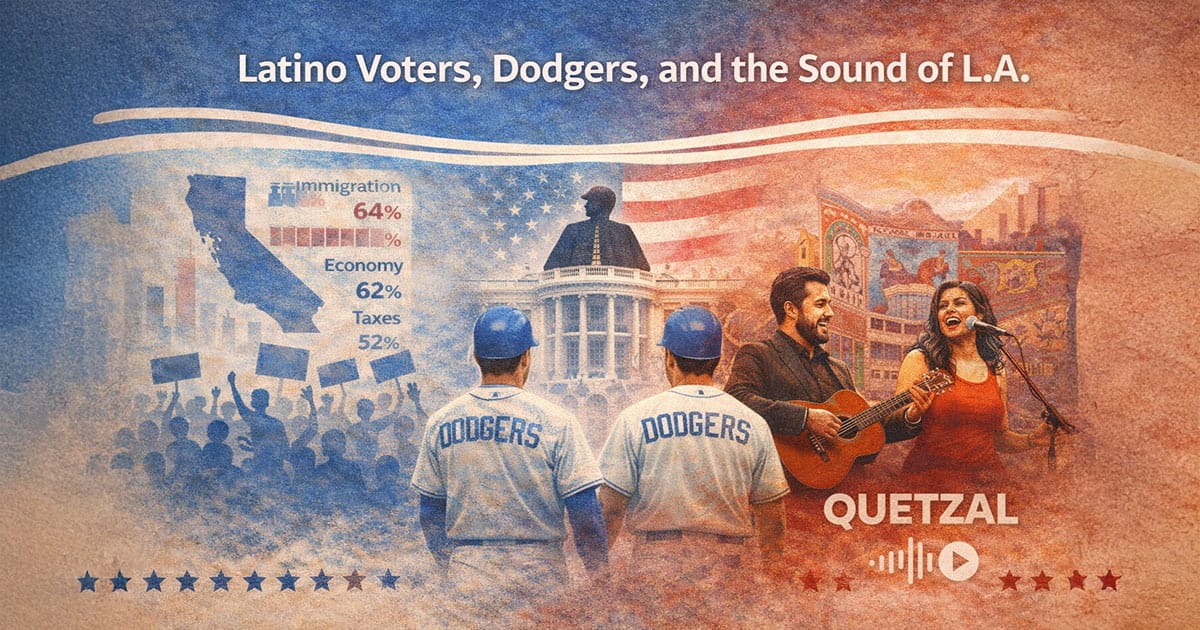
This week on The Signal, Dino explores the political mood of Latino voters in California through new statewide polling on the economy, immigration, democracy, taxes, and leadership. Then the conversation turns to the Dodgers and the controversy over a White House visit under Trump. Finally, the program closes with a look at Let the City Speak, a new documentary tracing the music, activism, and East L.A. legacy of Quetzal. Aired live on 90.7 FM KPFK Los Angeles on March 7 2026.
This is viewer supported news. Please do your part today.
TRANSCRIPT
This is a rush transcript. Copy may not be in its final form.
00:00:01:14 - 00:00:12:13
MUSIC INTRO
The whole run by a handful of greedy bankers and CEOs who nobody elected. What can't possibly last?
00:00:12:15 - 00:00:16:03
MUSIC INTRO
I'm going to tell you we're going to change.
00:00:16:05 - 00:00:17:15
JOSE MADERA
But you really only have to remember.
00:00:17:18 - 00:00:25:15
MUSIC INTRO
To work towards. It. Come on.
00:00:25:17 - 00:00:55:12
DINO
Good afternoon, Los Angeles, and welcome to The Signal. News, information and analysis. I'm your host, Dino. Coming to you live from the studios in Glendale, California. And on the signal, 90.7 FM, Los Angeles, 98.7 FM, Santa Barbara, 93.7 FM San Diego and 99.5 FM in Ridgecrest, China Lake and of course online at kpfa.org. Hope everybody's doing well.
00:00:55:14 - 00:01:24:16
DINO
And welcome back. I want to first take a moment to acknowledge, recognize, thank all the listeners, sponsors and supporters who, sustaining members who came back to us and supported us during this recent fund drive and support this democratic experiment, this democratic experience that is Kpfk. So thank you. Without you, we are not on the air, including yours truly.
00:01:24:18 - 00:02:10:11
DINO
So today we have a fun packed, program. We got, several important issues that we're bringing back online. In fact, we are literally revisiting a few of the issues that we've covered in the past. Today we have a a program that looks closely at the political moment we are living in. And we'll begin with new research examining the mood of Latinos across California, a new statewide survey, or a continuation of a statewide survey conducted by our friends at Zona Strategies, takes a deep look at how Latino voters are thinking about the economy, about immigration, about enforcement issues, democracy, taxes, and of course, the proverbial political leadership.
00:02:10:13 - 00:02:33:21
DINO
The findings suggest that something important is shifting. Now, we've heard this before, right? The sleeping giant is a shift among voters. Well, Zaino took another look at that, a recent look at that. And being that this is an election year, we are going to take a deeper dive into that. Later in the program, we're going to go down a different rabbit hole.
00:02:33:22 - 00:02:58:18
DINO
And that is on the question that is, remaining hot topic here in the L.A area. And that is should the Dodgers accept a white House invitation? I believe they already accepted it. So they'll be visiting with the current administration, whom is? Well, to say the least, somebody in this, community in greater, part of the state and country, and for that matter, the world.
00:02:58:18 - 00:03:25:05
DINO
Right. It's like, not very well like. So they'll be going, to the white House. It's, what many call a traditional part of winning a World Series. But many in the community are saying, hell no. So we'll be talking, with the organizers of a petition that are calling on the Dodgers to reject that invitation and stand with their fans, with our community.
00:03:25:07 - 00:03:45:23
DINO
And in our final segment, we turn to a little bit of music and culture. We'll be joined by filmmaker Akira Bosch and César Flores of the band Kitsune to discuss their new documentary, Let the City Speak The Sonic Journey of Ketzel, which, by the way, the world premiere is tonight and we'll have them on the air with us.
00:03:46:00 - 00:04:11:12
DINO
The film traces more than three decades of music, activism and cultural work rooted in East Los Angeles. And of course, we can't. You know, we can describe countless, countless three decades of experience. I certainly remember them for the last three years. And before we get started, I do want to announce a special announcement next week here on the Signum.
00:04:11:14 - 00:04:49:03
DINO
We'll be joined by one of the candidates, incumbent, Heidi, the city attorney, city attorney of L.A., Heidi Feldstein. Sotto will be joining us for a deep dive into her campaign to stay in office. And this is one of the more consequential races happening right now in the regional politics of Southern California. L.A., the L.A. city attorney, we actually had the other candidate a few weeks back, Marissa Roy, who's making quite the run and grabbing quite the attention.
00:04:49:05 - 00:05:16:01
DINO
So we now bring, L.A. City Attorney Heidi Feldstein, who will be with us, actually for the full hour, discussing her record, her candidacy, and why she should stay in the job. And, you know, I want to point out one thing. In the case of our station, in the case of this particular broadcast venue, this is the heart of progressive media, progressive audiences.
00:05:16:03 - 00:05:47:09
DINO
And it goes without saying that there is a shift happening not only in this city and in this state, but across this country, in which progressive candidates from Mamdani to now, the challenge against L.A. mayor, progressive candidates are making quite the run for political offices. And this is one of those offices. That's not to say that those who are there are not progressive, will hold progressive values, but there are some clear differences and we'll be exploring that.
00:05:47:09 - 00:06:25:11
DINO
So next week on the signal, starting at 12 noon, L.A. City Attorney Heidi Feldstein sort of joining us in studio. So with that said, we'll get right into it. So last year on this program, we invited the folks at research to talk to us about prop 50 findings. They conducted a survey. And our audience, you all were able to hear, about the findings at the time, again, regarding prop 50.
00:06:25:13 - 00:06:51:03
DINO
Well, the folks at Signal Research went back to those a numbers decided to really, you know, crunched the data. Sometimes when folks do these data research, these surveys, there's a lot of data that's collected. And we'll see particular issues come to the surface because a lot, a lot of times you surveys, for those of you that don't know, will include a variety of different questions.
00:06:51:03 - 00:07:14:02
DINO
And you're able to extract content, in one particular field, one particular area, line of questioning. And you, as a result, have data points that you can point to. Well, last year's finding on prop 50, our audience heard about that. And since then, the folks at Sumo Research have been crunching the numbers. The phone numbers, and now have a thought.
00:07:14:02 - 00:07:40:03
DINO
We have a persona to serve to us and describe the full data of this California wide survey. Deep. Look at voter attitudes on the issues like the economy, immigration, democracy, taxes and leadership. Joining me now is Nora Preciado from Sunil strategies. Partner. And I'm here to break it down for us.
00:07:40:03 - 00:07:50:07
DINO
Not a describe first walk us through what the survey was and describe what are some of the unique findings that came out of it. Now.
00:07:50:09 - 00:08:12:20
NORA PRECIADO
Good afternoon. Thank you for the invitation. We're excited to share some of our findings. This is a follow up to the process. The findings your audience heard from me about last year is when we have released the complete California wide survey, which is a deep look at Latino voter attitudes on issues like you mentioned, the economy, immigration, demography, taxes, leadership.
00:08:12:22 - 00:08:44:11
NORA PRECIADO
And I just want to note a few things that make this poll unique. One is a bilingual methodology, right? We conducted in English and Spanish with outreach via phone calls, emails and texts to about one 1100 respondents, including an intentional oversample of voters who crossed party lines between 2020 and 2024. And again, as a reminder, this poll took place in September and October of 2025, which gives a real proximity right to the November election.
00:08:44:13 - 00:08:51:01
NORA PRECIADO
But it was also paired with our March 2025 focus groups for a more qualitative depth.
00:08:51:03 - 00:09:16:18
DINO
Now, the mood of Latino voters right now, you know everybody. It seems like the last couple of elections folks look towards the Latino voter, and we know that for some time and some races and some particular regions, Latino voters are indeed making a difference. What did the survey find about how Latino voters are feeling right now about, the economy and California's direction?
00:09:16:20 - 00:09:41:21
NORA PRECIADO
So the big picture is that although this electorate has historically lean more helpful than other groups that shifted, the survey findings tell us a more complex and urgent story than what was covered in my initial prop 50 segment. One was real implications for the 2026 elections. On the economy, we see frustrations run deep. Our poll found that Latino voters.
00:09:41:22 - 00:10:15:17
NORA PRECIADO
I'm just worried about inflation. They reached a much broader conclusion, which is this system isn't fair to people like them. Nearly two thirds said the economy is unfair to working people. Most say California is too expensive to live in, even though they are aware that wages are higher here than in many other states, and only about 1 in 3 of those we surveyed rates our own finances positively, and nearly half expect things to get even worse over the next year.
00:10:15:19 - 00:10:44:08
NORA PRECIADO
And surprisingly, the messages that resonated most with these folks were not purely political. They were about corporate accountability, price gouging, and rebuilding the middle class. And then in terms of, what voters think about California, the survey shows that California specific frustration is real and growing, although not hopeless. More than half of those that we talked to say, California is on the wrong track.
00:10:44:09 - 00:11:04:15
NORA PRECIADO
Three and four rated the state's economy negatively. And I think it is important to note that the most popular economic position was actually not anti-government. It was about rebuilding the California dream, which to this folks meant access to housing, jobs, and middle class opportunity.
00:11:04:16 - 00:11:31:23
DINO
My guest is not appreciate your partner SEO at Senior Strategist. Discussing the additional findings that has come from the, survey they conducted, a survey that was first shared with us here last year during the prop 50 campaign. And she's back now today to give us the full story and possibly and tell us a little bit more about what Latino voters are thinking and not on the issue of immigration enforcement and the economy.
00:11:32:01 - 00:11:45:09
DINO
The survey asked voters directly about Ice raids and immigration policy. What did they say? What is the data show about how they connect enforcement to economic concerns?
00:11:45:11 - 00:12:13:10
NORA PRECIADO
Yeah, this is a really interesting part of the poll on immigration. We see strong views but very nuanced positions. The findings challenge, some common assumption assumptions about where Latino voters stand. There is strong opposition to Ice workplace rates, about 73% of those polled oppose them, 61% strongly oppose them. And there was also very strong opposition, rates.
00:12:13:16 - 00:12:47:21
NORA PRECIADO
To race at sensitive locations like churches, schools and hospitals. And that opposition ranged between 82 to 86%. Well, a majority of those we talked to say that, you know, immigration enforcement is hurting the economy by removing workers. 64% of them actually said that enforcement is hurting businesses by driving out those workers. And not an unsurprising finding is that nearly 7 in 10 say racial profiling of Latinos is actively occurring.
00:12:47:23 - 00:13:07:05
NORA PRECIADO
And obviously, as you know, from the litigation that was originated here in southern California in September, the Supreme Court of the United States cleared the way for Ice to consider race, employment and speaking Spanish as grants for immigration enforcement. And so we see that kind of surface in this poll.
00:13:07:08 - 00:13:34:07
DINO
So clearly. And let me just make this point so, so clearly something that we have noted and we put it on extensively, the Vasquez Perdomo suit, alleging this poll seems to support and certainly our community is not falling for it. They see this for what it is. It's a whole other thread of racism. But tell me more on the economy and immigration.
00:13:34:09 - 00:14:04:22
NORA PRECIADO
One of the most striking findings from this poll is that the messages that link immigration enforcement to economic harm, including worker shortages, rising costs, disrupted supply chains. Those outperform single issue messages by double digits. Wow. So, for example, among younger Latino men, the combined message produced a swing of more than 40 points. Wow. This tells us that, yeah, it's it's really, stark.
00:14:05:00 - 00:14:10:09
NORA PRECIADO
This really tells us that the economy and immigration are seen as one issue now.
00:14:10:11 - 00:14:28:13
DINO
Okay, okay. Okay. Okay. So, all right, well, let's let's talk a little bit about some of the other issues in messaging and how that resonated. Well, one of the issues, in particular was on taxes and democracy. What are the concerns there?
00:14:28:15 - 00:14:58:07
NORA PRECIADO
Yeah, there were a couple of issues that really rose to the top, as well as concerns, to this electorate. We see that on taxes and democracy. The concerns are across the board. This ranks among the top issues, but are often overlooked in favor of bigger headline, sexier findings like on immigration and the economy. But about 3 in 4 respondents said that taxes are a high concern to them, and 7 in 10 said the same about protecting democracy and the rule of law.
00:14:58:09 - 00:15:16:19
NORA PRECIADO
And so we see that both of these issues are connecting back to the same threat that we see running through the data. Like you know, voters are paying close attention to whether the system treats working families, fairly and whether their voice actually counts. Right. There was also some go ahead, go ahead. No, no.
00:15:16:19 - 00:15:19:00
DINO
Go ahead. Continue.
00:15:19:02 - 00:15:43:19
NORA PRECIADO
No. I think another really interesting topic that surfaced in the poll is in regards to political alignment. Okay. The findings in this, the survey, are pushing back against two popular narrative, the first one being that Latino voters are coming back to Democrats, and the second that Trump 2024 gains with this electorate, are a, signal electing realignment.
00:15:43:21 - 00:15:57:05
NORA PRECIADO
We see in the poll that those voters who switch between Biden and Trump were the least subtle group in the survey, and they are genuinely up for grabs. So they are the visible and movable. So,
00:15:57:07 - 00:16:17:00
DINO
So, so what you're telling me, and there's a concept out there that some of us have navigated in the past. This idea of the Latino vote is a Latino bump. Now, this idea that there is a core demographic group among Latinos that sometimes, make up the necessary bump in a given election to sway one way or another.
00:16:17:00 - 00:16:38:21
DINO
And what you're telling me, if I understand you correctly, is that indeed, that seems to be the case based on your data, which is they're up for grabs. And what either the administration is doing or what the Democrats are not doing, will be completely, will determine how these Latino voters go.
00:16:38:23 - 00:17:13:19
NORA PRECIADO
Yes. We are seeing, according to this poll that Latino voters across the board are evaluating their leaders through a fairness lens, not a party loyalty left. They, in in that sense, they're looking at leaders who are consistent and follow through, and they are moving away from those seen as backing down regardless of party affiliation. And they do want to know, just because we're in California, Governor Newsom did receive the highest rating, about 42% among public figures for his efforts to support the interests of like new communities.
00:17:13:21 - 00:17:19:22
NORA PRECIADO
And obviously not surprising, President Trump rated, much lower at around 18% with this electorate.
00:17:20:02 - 00:17:44:23
DINO
Well, and not I know that we got to let you go, but let's close this out. 2010 2026 is in full motion here. We at the, at The signal have been covering politics through our special series, politics and Beer. In fact, next week we have, one of the more consequential races, the incumbent, Heidi Feldstein, Santos L.A. city attorney, will be with us.
00:17:45:01 - 00:17:51:20
DINO
What is, what is what should we be prepared for as 2026 continues to roll on?
00:17:51:22 - 00:18:14:08
NORA PRECIADO
I think the takeaway is California has the largest Latino electorate in the country. So the attitudes that we're seeing surfaced in the survey are going to shape, right, statewide and congressional races, particularly in districts with high concentration of Latinos. But we also are to new strategies, view this as a blueprint for national Latino engagement in both 2026 and 28.
00:18:14:10 - 00:18:22:22
NORA PRECIADO
And that story has been written. It's been written here and now. So we hope this ad is useful for those doing civic engagement and trying to reach Latino voters.
00:18:23:00 - 00:18:36:18
DINO
And the story you heard it here with not up the door, partner Carlo Edson of Strategies know that. Thank you very much for joining us again. We hope to bring you back as the campaigns continue to flourish. Have a wonderful afternoon.
00:18:36:19 - 00:18:41:05
NORA PRECIADO
Thank you. You, too.
00:18:41:07 - 00:19:07:09
DINO
Well, let's, let's continue. I mean, look, you heard it here, folks. I think this is I want to point out the obvious. This is inevitable. I know that for years we have been hearing the whole concept of the Latino giant, you know, Latino voters making a difference. And every so often, some of us, in the political punditry world, kind of get surprised we don't have a lot of the big turnout, although we know the numbers are there.
00:19:07:11 - 00:19:38:01
DINO
But that is changing. Like it or not. And I think it's time that we start taking this more serious than ever before, just like we are on this next topic. Now, many of you are well aware of the fact that L.A. is a baseball town and more than ever before, as the last two years, we saw the Los Angeles Dodger, the hometown, the hometown Blue Team, take the World Series.
00:19:38:01 - 00:20:10:08
DINO
And with it came all the excitement, the fandom that is, being a World Series or a championship city. This is not new to L.A., but it's come with a significant one. I will describe Steve on this topic, right? Not on the topic. In fact, let's be more clear on the team. If you've ever been to a baseball game in recent times, you know that, well, it's a Latino experience, let's call it what it is, right?
00:20:10:08 - 00:20:39:23
DINO
I mean, how you got money? I just playing in the background, you know, it's, it's an Asian experience. Sure. It's a white experience as well, but it is dominant Latino and one of the biggest challenges that we've experienced in recent times is, of course, this thing that many of the Dodgers, including the Dodger management and fans alike, are calling the tradition that comes with winning a World Series, which means you get to go to the white House, meet with the president, do the photo ops.
00:20:40:01 - 00:20:44:15
DINO
But let's be honest, we have a.
00:20:44:17 - 00:21:09:07
DINO
President in office. Sly, I'm looking at my engineer and trying to compose my words because, you know, this is a delicate topic, but we have a president that can, you know, undeniably, undeniably be described as a authoritarian, authoritarian, racist bigot who talk about measure, in my words. Right.
00:21:09:09 - 00:21:43:20
DINO
Who has persecuted our communities now for coming up on a year him and his cronies have, devastated families time and again. There is a question. Should the Dodgers stand by their base, stand by their fan, stand by the communities that have built this and deny the white House visit? Joining me now is, Jose Madera of the Pasadena, remind me of the title, the Pasadena,
00:21:43:22 - 00:21:45:06
JOSE MADERA
Community job center.
00:21:45:06 - 00:22:10:07
DINO
Community job center. You know, I had it in my notes and they got scribbled up in the chicken scratch. Jose, your organization, along with the, National Day laborers, organize organizing network created a petition last year asking an open letter asking the Dodgers to please say no, stand with the community. Tell us about that.
00:22:10:09 - 00:22:33:07
JOSE MADERA
Yes. So me, myself again, been a long time Dodger fan. And my dad, when it came to this country, when Fernandomania was, you know, big and we found that love and passion for the Dodgers. And he gave it to me and my brothers. And I remember going to the stadium, Dodger Stadium and just, you know, cheering on the Dodgers.
00:22:33:07 - 00:23:07:01
JOSE MADERA
So learning about what it means to bleed Dodger blue, right. And that love and that passion again is the same love and passion that we have for our community. And like you were mentioning again, we have an administration president and his has been sending in ordinary people in masks, people in, unmarked cars, to the thief and to our communities and in order to into our streets and finally kidnaping fathers mother steals the earth and separating families.
00:23:07:03 - 00:23:33:00
JOSE MADERA
And the community is still mourning, you know, that. And that's why we've asking our beloved Dodgers not to go to shake the hand of this person that's creating this harm and this terror, in our communities. And that's why we have this petition, people can go to ace out of a later org and sign the petition, which, right now there's more than 20,000 people that in the petition.
00:23:33:02 - 00:23:47:06
JOSE MADERA
And again, we want more to same and again to show this, this solidarity and unity again, that we don't want our Dodgers or beloved Dodgers to go to the white House and sit behind again, this person that, during the pandemic to our community.
00:23:47:08 - 00:24:08:23
DINO
And who said, let me allow me to read it. It's actually, you know, very simple to the point. And what you all wrote is the following. And I want folks to try and follow along, three small paragraphs. Bear with me. The Los Angeles Dodgers have always been more than a baseball team. They're part of the spirit who we are as a city.
00:24:08:23 - 00:24:37:05
DINO
The team represents our neighborhoods, our families, and our shared love for our diverse communities. But right now, our community, our city is under siege. We need them to stand with us on the right side of history. Please join our petition by asking the Dodgers to not attend the traditional ceremony at the white House. Ask to ask the team to honor the unity, integrity and diversity they themselves represent.
00:24:37:07 - 00:25:01:12
DINO
They cannot stay silent as our families and neighbors face violence, detention and deportation by visiting a president who has used his power to harm the most vulnerable, the team would be turning its back on the very people who fill the stadiums, wear the jerseys and give the team the heart. It's hard by encouraging the team to do the right thing.
00:25:01:16 - 00:25:19:00
DINO
We will show the white House that Los Angeles stands for compassion, dignity and solidarity with immigrant neighbors. I mean it, it's a no brainer. Has the have the Dodgers responded to you all?
00:25:19:02 - 00:25:39:18
JOSE MADERA
Not only they haven't they haven't done anything. There's we haven't got any word from the Dodgers. But again we just keep letting people know like that again to share their, their words. And again, just like myself. And, you know, many people have this love and passion for the Dodgers, you know, many memories, many history.
00:25:39:19 - 00:26:03:07
JOSE MADERA
And again, it's their love and passion that we have a long time Dodger fan is that we're asking again, our beloved Dodgers not to go to the white House. And again, just like this past year where a lot of us were cheering the Dodgers, in their championship run. You know, a lot of us that, stayed awake in that 19 inning game, we were watching the last game and and cheering them on.
00:26:03:09 - 00:26:27:02
JOSE MADERA
But again, there's joy, and passion that we have for daughters. And again, like, like we mentioned in the petition, the Dodgers play a big role in our city. There's a, you know, fabric of what is L.A.? But many and many of the community in L.A. is being home right now. I mean, that's the base of the fan base.
00:26:27:02 - 00:26:30:00
JOSE MADERA
So we're asking them, hey, don't go to the white House.
00:26:30:02 - 00:26:55:17
DINO
Who says, stay with us? You know, we we put out a message on social media saying that we would take calls. And we do have actually a a baseball fan on the line who wants to chime in? Miguel Paredes, you are a baseball fan, a devoted baseball fan. You describe yourself as a devoted baseball fan, but are still supporting the game of baseball.
00:26:55:17 - 00:27:16:14
DINO
Tell me what your thoughts are on this issue of the Dodgers visiting the white House. And how do you consolidate this? I mean, how do you mitigate the fact that on the one hand and look for transparency, this is a delicate issue for me as well? I'm a I'm a strong fan of the Dodgers, and in fact, I go to well over two dozen games a year, if not more.
00:27:16:16 - 00:27:24:06
DINO
And I've had a hard time with this issue. But, Miguel Paredes, tell us what your thoughts on this are.
00:27:24:08 - 00:27:41:19
JOSE MADERA
Thank you for for the time. And, you know, shout out to Roseanne and all the work that they're doing with Andy. I think as a fan, it's important for us to voice our opinion and to be as vocal as we can be when we have those opportunities. I remember when many of us wanted to retire.
00:27:41:19 - 00:28:03:01
JOSE MADERA
Number 34 for Fernando Valenzuela. The Dodgers have certain rules about how that's supposed to happen, but it was really because of the fans, like myself, when I would run into Stan Carson and I would let him know. So I want to urge fans to you know, respectfully share your concerns with the folks, on the Dodgers that you see out and, and in the stadium.
00:28:03:01 - 00:28:30:12
JOSE MADERA
And, you know, I think it's an important opportunity for us as well as a community to engage our diverse, population here in Los Angeles. There's thousands of Japanese fans, that come to the stadium. And I think it'd be important for us to engage, with these fans and, help them also voices concerns, because if it's just coming from the Chicano Mexican-American community, the Dodgers obviously have to listen to us because we're the largest population in terms of their fan base.
00:28:30:12 - 00:28:52:11
JOSE MADERA
But I think we engage other, you know, season ticket holders as well who have, you know, an opportunity to share, their words. I think it'd be, great. I myself, remember, you know, the Dodgers growing up, I think I'm able to make some really great memories thanks to Shohei Ohtani and the team with my two year old son and my wife.
00:28:52:11 - 00:29:14:03
JOSE MADERA
And I think, it's important for for us to remember that, you know, sports are part of humanity. And, and it's very closely tied to our, you know, civic pride, if you will, here in Los Angeles. But we need to take that opportunity to be vocal in support of, having, the Dodgers not visit the white House and, the petition by Andy Lau.
00:29:14:03 - 00:29:37:08
JOSE MADERA
And so, you know, I think folks like Keith Hernandez have spoken out and that's great. But, you know, let's imagine, you know, that this game was being played in the 1940s. And they're rounding up, you know, Japanese fans, for example, I'm sure Dave Roberts and Shohei Ohtani might be a little bit more vocal. If other folks in the community were able to share their concerns as well.
00:29:37:08 - 00:30:05:14
JOSE MADERA
But, I look forward as a fan, to this season and to the three peat. And I think for myself, I the way I justify it, if you will, is that, I separate, the workers from the owners. Right. The baseball players and the team are one thing. The owners and their investments are something else. And, you know, hopefully we'll continue to understand, what it is that the Dodgers are actually doing versus some of the theories out there in the community that, you know, are very serious, obviously.
00:30:05:15 - 00:30:29:06
DINO
And you know what? I'm glad you brought that up, because that's something that I've personally I've dealt with, among friends, colleagues, allies, and even in the public with folks who are, you know, very passionate about this topic and rightfully so. You know, as, as I was saying, pointed out and I think many of my guests over the last year pointing out what's happening to our community is devastating.
00:30:29:08 - 00:30:56:23
DINO
What do you say when people say, well, look, man, you know, blah, blah, blah b.s., you should stop going because by default, you being there, even if it is in moral support of those workers, you are still, at the end of the day, supporting the Dodgers financially by way of purchasing the ticket. Right. I appreciate the argument that you're making that, you know, at the end of the day, we still are supporting, you know, employment.
00:30:56:23 - 00:31:09:18
DINO
We're supporting our own community. But what do you say in response to that? When the friend says, hey, you know what we call BS, man, we should stop going.
00:31:09:19 - 00:31:36:11
JOSE MADERA
I mean, again, you know, every person justifies this money for myself. I'm a fan of baseball. I'm a fan of Los Angeles. I have a two year old son that that loves baseball on his own. And personally, we brought him home. Was the first homerun that Shohei hit for me. I want to continue to educate him and other folks in the community about, what we can do, as fans and what we can do to continue to take ownership of this team.
00:31:36:11 - 00:31:58:01
JOSE MADERA
At the end of the day, this team has Los Angeles, on its back for our city. And we need to continue to be, vocal in expressing, our support for, you know, petitions like Andy Laws and for the Dodgers to continue to speak up about, things like these Ice raids. But I think the.
00:31:58:03 - 00:32:23:21
DINO
I think we might have lost me. Go. Yeah. You know, let me go back to you now. You yourself, if it's okay. You yourself have been directly impacted by these Ice raids. And not only are you helping spearhead this project, on behalf, at the behest of the National Day Laborer Organizing Network, and our community at large, you yourself have been directly impacted.
00:32:23:21 - 00:32:32:19
DINO
You were arrested as a result of your activities, including our community. Tell us more about that. Jose.
00:32:32:21 - 00:32:59:13
JOSE MADERA
Yeah. Just like many. Again, with all this hate and terror coming into communities, many organized, and are being legal observers and, I was being a legal observer on January 7th, the day the, the one year anniversary of the in fire when they lay fires. Yeah. I was being a legal observer and there was an Ice agent, around the area in Pasadena for dinner, and I became a legal observer.
00:32:59:13 - 00:33:26:11
JOSE MADERA
And then again, this agent took us to the front of the Pasadena Police Department. And instead of stopping the Pasadena Police Department and stopping the Ice agent, they stopped me and arrested me. And like I just said, just for being a legal observer and, again, protecting my community. And again, that's what we're seeing now. And again, we've been seeing that too often, other cities or something in El Monte, and Alhambra, those type of tactics.
00:33:26:16 - 00:33:34:09
JOSE MADERA
And again, it's the state that we're living in. And again, we're just protecting our city. We're just, you know, we city and protecting our neighbors.
00:33:34:11 - 00:33:59:01
DINO
And with it, if I can ask you, and we as we try and wrap this up for you are, who are right there on the ground, you know, front line of defense. What do you say? I ask you the same question I asked Miguel. When folks, you know, hell, I'll use Miguel as an example. Right?
00:33:59:01 - 00:34:15:02
DINO
Some folks say, well, look, I'm supportive, I get it. I want ice out of L.A., but I just can't get myself to boycott the Dodgers because, well, it's the Dodgers, you know? What do you say to them, if anything?
00:34:15:04 - 00:34:38:02
JOSE MADERA
Well, one, I think we all, again, we love our Dodgers. And, I think many people see in many different ways, people can boycott it. People can ask us, you know, ask the Dodgers again not to go to the white House. People can be vocal. You know, many people can be many different things. We have this love and passion for the Dodgers.
00:34:38:04 - 00:35:03:05
JOSE MADERA
And it's not to stop that, but it's also for us to hold the Dodgers accountable. And I think for most people, people don't want to see hate and terror in our communities. People don't want to see, men, coming into our streets and kidnaping people. I think for most people you can agree on that. And that's just, again, just holding the Dodgers accountable not to go to the white House again.
00:35:03:05 - 00:35:10:23
JOSE MADERA
For me, myself, I usually go to 10 or 15 games, a season. Last year I didn't go to any.
00:35:11:01 - 00:35:12:07
DINO
Right.
00:35:12:09 - 00:35:33:04
JOSE MADERA
And, you know, many people that I know, family members and friends also did the same thing, but also many people that I know. Family and friends also went to Dodger, and will continue to go to Dodger games. But the sense is like, hey, let's let's love our Dodgers. Just continue to root for them, but let's also hold them well and let them know, like, hey, are you with us?
00:35:33:07 - 00:35:53:15
JOSE MADERA
You know, again, this community has been with you when it's the worst year to the best championship years. We're still here with you and we're asking you to be with us too. When we're seeing this hate and terror coming into our communities. And we're simply just asking, don't go to the white House and shake the hand of the person that's creating this hate and terror.
00:35:53:17 - 00:36:19:00
JOSE MADERA
I mean, for for me, I was born and raised in Pasadena, and it's a it's always a pride. And we know what Jackie Robinson means, and we know what 42 means to us. We know that. Well, you know, we're an elementary school. And again, thank you, Robinson, for all is right. Fight for justice. And he said again, no American is free in this country until all of us are free.
00:36:19:02 - 00:36:26:18
JOSE MADERA
And that's what we're asking. Again, the legacy of Jackie Robinson to continue within the Dodgers and with the whole city.
00:36:26:20 - 00:37:03:14
DINO
Let's, let's give it another shot at, at the website. My guest is Jose Madeira, director of the Passing the Community Job center and a leader at the, in the labor movement here in Southern California. He's also with the National Day Laborer Organizing Network. And, we're talking about the Dodgers, the visit, the the argue, what they argue is the proverbial visit to the white House part of tradition, but also the big concern that, the Dodgers have a debt to pay to the community that has uplifted them.
00:37:03:16 - 00:37:18:10
DINO
Where can folks go to, learn more about it, just as this movement itself and, to sign the petition so that if you, if you want to join the petition, where do they go?
00:37:18:12 - 00:37:41:22
JOSE MADERA
Yes, you can go just again to the website, which is ice out of L.A. dot org. And then there you'll see the petition and sign it. And we are asking people to share it, to share to many of the friends and fellow Dodger fans, family, again, so we can show this strength and unity. Again, as beloved Dodger fans, that we don't want our beloved Dodgers to go to the white House.
00:37:42:00 - 00:38:10:03
DINO
Wonderful. My guest has been, Jose Madera, director of the Pasadena Community Job Center, part of the National Day, Laborer Organizing Network. And, we also had a fan of and, who, joined us. Miguel Paredes, I want to thank you both for being with us. As we, talk about this. The season opener is around the corner, and you know, we are all going to have to have that come to Jesus moment as the season opens up.
00:38:10:09 - 00:38:14:03
DINO
I want to thank you both for being with us. We'll be right back.
00:38:14:05 - 00:38:15:08
JOSE MADERA
I, I'm going to tell.
00:38:15:08 - 00:38:26:03
Speaker 6
You what I'm you are listening to, but you really only have to remember to talk to a signal. There's a signal.
00:38:26:05 - 00:38:38:15
Speaker 6
Coming by with mighty Dino only on Kpfk 90.7 of FM Los Angeles.
00:38:38:17 - 00:38:41:07
Unknown
In your.
00:38:41:09 - 00:38:43:03
Unknown
Living room. I'm not.
00:38:43:05 - 00:38:46:19
JOSE MADERA
Saying your.
00:38:46:20 - 00:38:47:01
JOSE MADERA
Tone.
00:38:47:04 - 00:39:22:03
DINO
And I said I don't get it. Welcome back to get our our final segment today. We're going to shift a little bit, and go away from the Dodgers and go away from some of the other politics we've been talking about and talk about the politics of music, which I got to say, I'm excited about this segment because I, you know, for transparency, there's a personal note for me as somebody who was born and raised in L.A. and in fact born, to this very, I think, live to this very music for quite some time of my life.
00:39:22:03 - 00:39:44:01
DINO
We're talking about a new documentary that's covering the sonic journey of Kid Sol. Well, let me let me give you the full title, Let the City Speak the Sonic Journey of cats On. It's a new documentary directed by film director I Get a Bosch that explores the 30 year history of the Grammy winning Chicano rock band Kid Song from the East Side.
00:39:44:01 - 00:40:03:21
DINO
Now for transparency, I lived on the South Side. I went to high school on the East Side, went to college in the valley on the west side. I don't think they make, you know, that makes me L.A. sly. I'm looking at my engineer and he's like, yeah, no, that's pretty much it. I remember the first time I heard that song.
00:40:03:23 - 00:40:42:19
DINO
Yeah, about 30 years ago, I wasn't, I think, on my way to college and thinking, what holy man this is something very different. As a young Chicano young growing up in a very diverse city, I was moved by it. And over the years, I've had the great pleasure of of meeting my next guest. And, you know, I will describe what I can only describe it as genuine artistry that reflects and has grown literally out of this community, out of these communities.
00:40:42:21 - 00:40:47:15
DINO
Gets on Flores with kids on guitar. How are you doing, man?
00:40:47:17 - 00:40:50:17
JOSE MADERA
Hey, Armando, this is Steve with you.
00:40:50:22 - 00:41:04:12
DINO
A long time, brother. Hey, listen, walk me through this, man. Give me the. For those, younger audiences. Younger than us. Maybe some that are listening for the first time. Tell us about the band, how it first came together.
00:41:04:14 - 00:41:29:03
JOSE MADERA
Yeah. So San is, the band that, has been around for 32 years. 33 years, something like that. And, it is a continuum of what I like, let's call them, like the, the fruits of the movements. Right? Right. And, and the movement isn't, you know, just the thing that happened in the 60s and 70s.
00:41:29:03 - 00:41:57:18
JOSE MADERA
It's a continuum of things that have been happening since, the colonial forces landed on these lands and began to, commit genocide and slavery and Jim Crow and all those moments. Right, of of injustice that continue today. And so the band is, is like the, the, the sonic, manifestation, for, for a particular time. Right.
00:41:57:18 - 00:42:18:13
JOSE MADERA
Time period and, and to date of what is happening on the streets of what is happening in our hearts, what's happening in our minds and in our bodies. And, and this is how we we have emerged and this is how we continue to exist as a band. Now, you basically, we. Yeah. Go ahead.
00:42:18:18 - 00:42:35:11
DINO
I was gonna say. So your band blends rock with traditional music, Americana forms like sound culture, you know, tell us how that started and how has that, you know, grown. What's been the evolution of that sound?
00:42:35:13 - 00:43:12:03
JOSE MADERA
Yeah. So Chicano music in general does that? We are a Chicano rock band, and we are a generation after Los Lobos. Who did that already, who have been doing that. And then Ritchie Valens is before them, and he did that, and Lalo Guerrero and Leda Mendoza and all these amazing protagonists. There's 100 here year history of our music that articulates the lived reality of our communities, and also that is in close relationship with the black community because Chicano music doesn't exist without black people or black music.
00:43:12:05 - 00:43:41:10
JOSE MADERA
And so to say that, you know, these are really important, moments and connections for us. Around how we exist and how do we create, you know, it's we grew up with soul music and funk and R&B and all these things, but we also grew up, you know, knowing about how to achieve music because in our communities, there were these, these people who thought it was important to learn these traditions and, and who, carried them for a generation so that we could have access to them.
00:43:41:10 - 00:43:41:21
JOSE MADERA
Right.
00:43:41:23 - 00:43:45:05
DINO
Right. So go ahead. Continue.
00:43:45:07 - 00:43:46:11
JOSE MADERA
No, no. Please. Please.
00:43:46:13 - 00:44:22:21
DINO
Well, you know, one of the things that I said to myself, I cannot not mention this because I think this is one of the first times that I remember meeting you and and your band and your family. Really? And that was, you know, tell us more about the history politics has played. I know you've made reference to this being part of the ongoing evolution of the movement, but you've also done a lot of work abroad in fact, I met you and Chiapas, Mexico, at the height of the separatist movement where you and the band, among others, were intimately involved in getting those voices out.
00:44:23:03 - 00:44:25:22
DINO
Tell us about that experience.
00:44:26:00 - 00:44:51:11
JOSE MADERA
Yeah. So I come from a family that is, deeply rooted in in movements, my parents, but also my, my dad's dealers and, and my grandparents, you know, it's been an ongoing thing for them. And, and so I inherited that that practice and that value system. So when I, you know, decided or when music decided about me, it had to have that thing with it.
00:44:51:11 - 00:45:13:15
JOSE MADERA
It could not just be like art for art's sake or, you know, you know, this sort of career in music without continuing to, to connect in deep, and meaningful ways. And then when the separatist movement hits, it's it's right around the time that the band is emerging. So it was and it caught like wildfire in the community.
00:45:13:15 - 00:45:34:09
JOSE MADERA
It wasn't just the band. It was like this whole movement of art and culture that was emerging from the East Side, you know, and really all over LA. But, for me, it was centered on the East side. And so we, we really began to, to become students of, the separatist movement and the teachings and the philosophies.
00:45:34:11 - 00:45:59:23
JOSE MADERA
And it was very inspiring. And we also, you know, didn't, didn't relinquish the things that we already knew and we had already experienced as Chicano people because we had we've come for a movement and we have, you know, deep, examples of what movement looks like for us. And that combined with this other piece was incredible. Actually, I remember the first time I met you was at the popular resource center in Highland Park.
00:46:00:01 - 00:46:09:16
JOSE MADERA
You began, and a couple other folks from from C came down. And, you wanted to talk about Alinsky.
00:46:09:18 - 00:46:15:04
DINO
I think was a minsky, probably Marx, probably a little bit of all of them. Yeah. No, you're.
00:46:15:04 - 00:46:15:14
JOSE MADERA
Right.
00:46:15:16 - 00:46:23:15
DINO
I, I forgot about I thought it was actually in, in chapel itself, but no, you're right. It was, it was still here on the east side I believe.
00:46:23:17 - 00:46:24:09
JOSE MADERA
Yeah. Yeah.
00:46:24:09 - 00:46:53:06
DINO
Highland Park and so at some point you come across, this brother from this tiny little town which I had to look up, and with this, with this segue to introduce, my other guests, Aquino Bosch, who, as I understand, Akira San Juan Bautista. I had to look that up. I never heard of it. One little town, population as of right now, about 2000 people.
00:46:53:08 - 00:47:03:18
DINO
How in the. How did you come down to become a filmmaker? And of all things, you get to cover this incredible topic of, cats on,
00:47:03:20 - 00:47:34:16
JOSE MADERA
Yes. It's true. I grew up in San Juan Bautista, which is, you know, Central Coast of California. It's not too far from Salinas. It's south of San Jose. And, it's best known because El theatrical Campesino is based there, and that is, you know, the theater company of Luis Valdez. Right. Which emerged in the mid 60s in Delano, supporting the UFW.
00:47:34:16 - 00:47:53:02
JOSE MADERA
And so Chavez and they found their home base in San Juan Bautista and, actually, they moved into a former packing shed because it's an agricultural region. And my parents house was literally right next door to the packing shed.
00:47:53:06 - 00:47:54:15
DINO
Oh, wow.
00:47:54:17 - 00:48:22:05
JOSE MADERA
And, Lewis's eldest son, his name was not Norwalk. And his second son, Keenan. They were basically, there's some of my best friends. It's really small town. Not much to do. So we became really tight and we started putting on plays at the theater. We became involved with the the official theatrical productions and, you know, Luis Valdez really inspired me.
00:48:22:05 - 00:48:41:16
JOSE MADERA
He, he got me into filmmaking because he was making he'd been making Zoot Suit and then later, La Bamba in 86. And so I was able to be on the set of La Bamba, you know, and just watching him work was just incredibly inspiring.
00:48:41:18 - 00:49:06:23
DINO
I imagine. So, yeah, I could totally see that. And. Yeah. So, so. Oh, mama. So you're you're all. You were all up in there, brother. You know, the Chicano brother from the Central Valley comes down, meets up with this other Chicano brother in the, on the East side. And I understood how our, you know, energy drink, you know, field research team.
00:49:07:01 - 00:49:24:19
DINO
Somebody told me that, apparently you had collected footage over the years, had this idea hanging around. And she described it as, you know, just tons of footage and material recordings. So this idea had been with you for quite a while. Walk us through that.
00:49:24:21 - 00:49:57:04
JOSE MADERA
Okay. So I moved to LA in 1994. It was after I graduated from college and moved in, to a loft with, graffiti artist friend of mine. His name is Joseph Montalvo, and he is the one that introduced me to the whole East Side, art scene. And, there was an event happening in downtown LA in 1994 called Big Cup Locos, which was produced by, Richard Montoya of Culture Clash.
00:49:57:06 - 00:50:21:03
JOSE MADERA
And I knew Richard because they had been putting on plays at the theater in San Juan Bautista. Right. So we had this relationship, and he invited me to come down and shoot, at a press mixer that they were having. And that was the first time that I met Ghezzal, because César was on the bill for Big Top Locos, and I interviewed César.
00:50:21:03 - 00:50:49:00
JOSE MADERA
That was the first time I ever got him on tape. And, it's it's like the rest is history. You know, we just became really good friends, and we started making all these projects together. I made music videos for them, shot a bunch of their live shows, did some interviews at random times, and all along I never really thought about making a documentary specifically about it.
00:50:49:00 - 00:51:14:23
JOSE MADERA
So because I was so enchanted with the whole, you know, East Side, art and music scene. And so I did collect footage on all these other bands too, that were that were plain and made music videos for them. Also. So I just felt really lucky to be able to just step into that environment and, you know, just be one of the, you know, documentarians of what was going on.
00:51:15:01 - 00:51:26:20
DINO
I actually remember Big Top local. I went to the event, I was, yeah, that same year of,
00:51:26:22 - 00:51:33:09
DINO
I think October, the fall of it. And it was at the Olympic Auditorium, wasn't it? Yes.
00:51:33:09 - 00:51:34:16
JOSE MADERA
Yeah. Yeah. Okay. Yeah.
00:51:34:18 - 00:51:51:09
DINO
I remember that. And. Okay, fast forward to today, and here we are. Today's a world premiere. When did you start production for the documentary? How long did it take you? And tell us about the screening tonight?
00:51:51:11 - 00:52:30:03
JOSE MADERA
Sure. So it was during Covid when everybody was in lockdown that gets all. And I started talking about, you know, the possibility of finally putting all this footage together and telling the story of gets out because I really did have the most footage on them, like, compared to any, any other artist or or group. And I had the time also to collect all this footage and digitize it and then start to transcribe everything and start to figure out how to put it all together.
00:52:30:05 - 00:52:36:05
JOSE MADERA
So that's all. And Martha were both instrumental in.
00:52:36:07 - 00:52:49:04
JOSE MADERA
In figuring out how to tell a story and all the disparate elements that could be pulled together in order to you know, convey what the band has really been about all these years.
00:52:49:06 - 00:53:05:03
DINO
And so, so as we, as we wrap up, could start coming back to you, what should the, audience, tonight and those listening and can still join, what should they be expecting? At tonight's event?
00:53:05:05 - 00:53:11:21
JOSE MADERA
Well, I think they they should be expecting to start getting feedback.
00:53:11:23 - 00:53:14:04
DINO
Yeah. We can hear you. Fine.
00:53:14:06 - 00:53:27:12
JOSE MADERA
Okay. Okay. Do you mind muting? Sure. So they should expect a story that is a critique on capitalism.
00:53:27:14 - 00:54:07:02
JOSE MADERA
That is a critique on white supremacy and patriarchy. It's, it's one story in many stories. As I mentioned, there was tons of bands, tons of artists, visual artists, photographers, theater people, on and on and on. And it's a it was a massive movement and that it just didn't go away. All of us have gone into all these different spaces where we're still organizing and building and, and, and ourselves transforming and also, you know, believing and tending to hope.
00:54:07:04 - 00:54:16:03
DINO
And so the screening is happening tonight. Tell us about the venue and how can people, participate, learn more about it?
00:54:16:05 - 00:54:45:01
JOSE MADERA
Yeah, it's at the our tiny theater in Little Tokyo. It's, the corner of San Pedro and second, and it's kind of in the plaza. You got to go into the plaza. But the art theater at, 6 p.m.. There's still some tickets. Three. So you can just come on down and, there's going to be a panel right afterwards.
00:54:45:01 - 00:54:52:11
JOSE MADERA
There's going to be some food, by this amazing, Palestinian, caterer.
00:54:52:13 - 00:54:52:23
DINO
Oh, nice.
00:54:52:23 - 00:55:03:21
JOSE MADERA
And then there's going to be, Fandango afterwards, we're going to assemble in community and play some, some kind of music to let me do in community.
00:55:03:22 - 00:55:26:04
DINO
Wonderful. My guest has been, Akira Bosch, film director of Let the City Speak The Sonic Journey of Guitar Link. It's on Flores of the band Kit on, once again at the Ohtani Theater. World premiere of the documentary happening tonight in Little Tokyo. Is there a website or an Instagram page? Folks can look you up at?
00:55:26:06 - 00:55:36:08
JOSE MADERA
Sure. We have an Instagram. It's let the city, the city speak. And also our website is let the City speak.com.
00:55:36:10 - 00:55:50:12
DINO
Fantastic. I want to thank you both for joining us. We look forward to having our audience, join you as well. I might myself, make the trek out there. And again, thanks for being with us and good luck tonight. We'll see you soon.
00:55:50:14 - 00:55:53:19
JOSE MADERA
Thank you for that. Thanks. Yeah. Thanks so much for having a wonderful.
00:55:53:19 - 00:56:21:19
DINO
So as we close out, folks, I want to thank everybody. Part of the production team, Sky rivers, my producer. Another one. But, and remind you guys that. Look, you know, today's program covered three conversations that speak to where we are as a community and where we may be headed. The research, segment that we discussed, at the start of the program, reminds us that Latino voters across California are paying close attention to the economy and to the question of fairness.
00:56:21:19 - 00:56:43:19
DINO
Many people feel that the system is not working for working families, and you're going to see part of that at tonight's, documentary, including the tone that we just heard. The debate about the Dodgers in the white House reflects another dimension of civic life in Los Angeles. Sports teams are not only entertainment, they become institutions that represent the identity of our communities.
00:56:43:21 - 00:57:10:04
DINO
And finally, the story of Kitson reminds us that Los Angeles has always been a place where music, culture and activism intersect. Indeed, in this program as well for many, for more than three decades, this band has used some as a storytelling opportunity. That's it for today. This is the signal news, information and analysis. I want to thank all our guests, our listeners, and thank you for spending your Saturday afternoon.
00:57:10:05 - 00:57:32:14
DINO
I'm your host, Dino, and we'll be back next week and again next week. Special program. We spent the hour with City Attorney Heidi Feldstein Soto, as we talk about one of the most consequential election campaigns in the city of L.A., big props to Sly River, our engineer, a producer in L.A., Barbara, stay tuned for my homies from the car show.
00:57:32:16 - 00:57:36:15
DINO
That's who I listen to when I start heading home. See you next week.
00:57:36:17 - 00:57:37:17
MUSIC INTRO
To head up
00:57:37:18 - 00:57:47:18
MUSIC INTRO
outside of my go to and like, see you if you say Revolucion pro.
00:57:47:19 - 00:57:50:00
MUSIC INTRO
Signor el Presidente.
00:57:50:02 - 00:57:55:14
MUSIC INTRO
Local de la making this movie, these.
00:57:55:16 - 00:57:56:08
MUSIC INTRO
Things I do.
00:57:56:08 - 00:57:58:19
MUSIC INTRO
And then it's on through.